



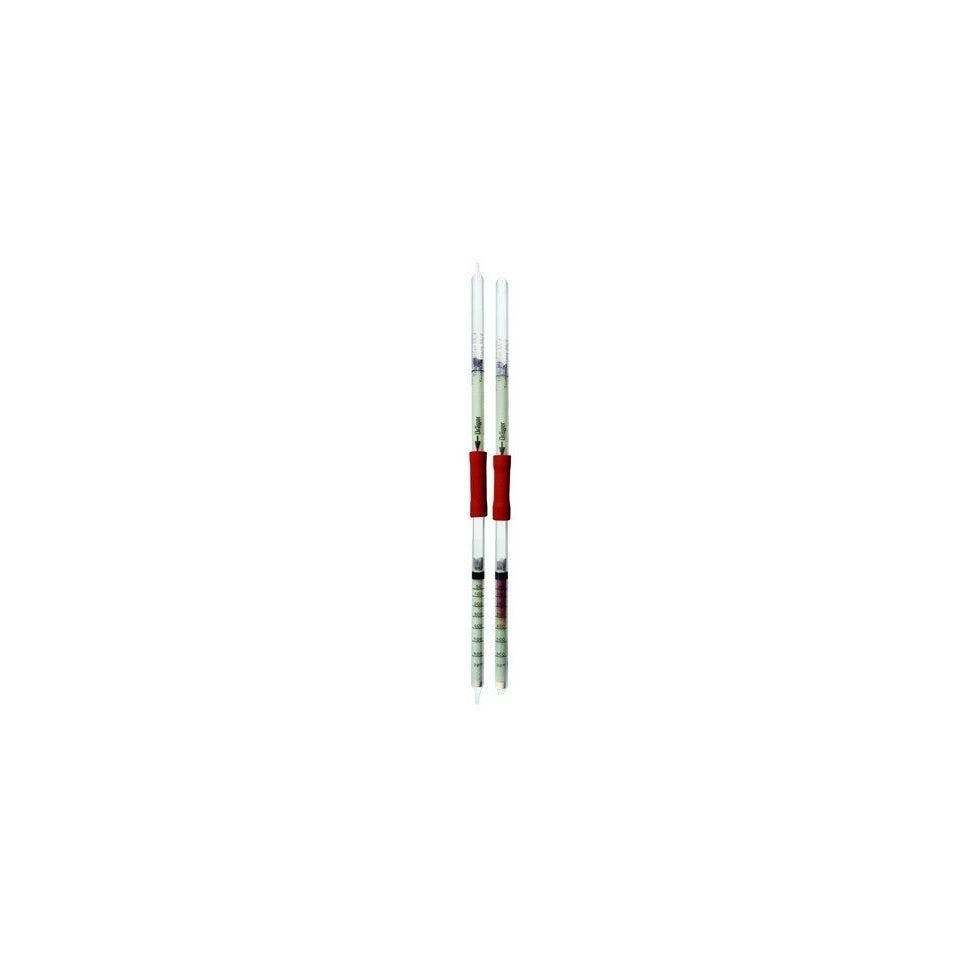

Drager Detection Tubes - Trichloroethane 50/d (Pack of 5)
Drager Short Term Detection Tubes: Detects a range of substances incl. Bromochloromethane, Chloroethane, Methyl Chloroform, Trichloroethane.
NOTE: This product has a shelf life of 2 years and comes in a pack of 5.
| Application Range | Determination of 1,1,1-trichloroethane in water/waste water |
| Drager Tube | Trichloroethane 50/d |
| Measuring Range | 0.5 to 5 mg/L |
| Number of Strokes n | 5 + 3 desorption strokes at clean air |
| Typical Stroke Time | 40 to 70 s + 20 to 40 s |
| Time for Measurement | approx. 550 s + 90 s |
| Sample Volume | 200 mL |
| Colour Change | grey - brown red |
| Temperature Range | 5 to 35 °C |
| pH-Measurement | not necessary |
| Measurement Range (mg/L) | Standard Deviation (%) | Temperature [°C] | Parameters B C |
| 0.5 to 5 | 25 | 5 to 12 | 0.0059 - 50 |
| 25 | 13 to 25 | 0.0059 - 100 | |
| 30 | 26 to 33 | 0.0054 - 200 |
Evaluation of Measurement
Calculate 1,1,1-trichloroethane concentration:
Y[mg/L] = A • B • (X[ppm] + C)
Cross Sensitivity
Perchloroethylene, carbon tetrachloride, dichloromethane and trichloroethylene are indicated with lower sensitivity. Petroleum hydrocarbons are not indicated.
Specifications
| Application Range | |
| Standard Measuring Range: | 50 to 600 ppm |
| Number of Strokes n: | 2 + 3 desorption strokes in clean air |
| Time for Measurement: | approx. 1.5 min |
| Standard Deviation: | ± 10 to 15 % |
| Color Change: | grey --> brown red |
| Ambient Operating Conditions | |
| Temperature: | 15 to 40 °C |
| Absolute Humidity: | 5 to 15 mg H2O / L |
| Reaction Principle | |
| a) 1,1,1-trichloroethane + IO3 –/H2S2O7 --> Cl2 b) Cl2+ o-tolidine --> brown red reaction product |
|
| Cross Sensitivity | |
| Other chlorinated hydrocarbons are indicated, but with different sensitivities. In the presence of aromatic hydrocarbons the indication is too low (e.g. 200 ppm 1,1,1-trichloroethane and 200 ppm toluene, the reading amounts to 1/4 only, i.e. 50 ppm). |
|